ROBAR saves hundreds of staff hours in IT Administration by virtue of its enterprise architecture and innovative web interfaces.
Even with the expertise and dedicated resources of an entire software company, developing and maintaining an FDA-strength labeling system is a considerable task. Thus, it is rarely " if ever " practical for a Life Science manufacturer to build the ideal system in-house, given the number of additional systems and commensurate work for which its IT group is responsible. Consequently, most medical device and pharmaceutical manufacturers end up with a custom label system that has numerous significant drawbacks.
Administrative Drawbacks of Homegrown Label Systems:
|
 |
Limited Functionality: Every business software system must
address the needs of two major stakeholders: those who use the system, and
those who administer the system. The result is typically a compromise with
major sacrifices on both sides. On the Administrative side, this often means
a de-centralized system with multiple stand-alone installations spread across
any number of business units and physical locations. Thus, IT is forced to
manage systems at the individual site level, or even user-level to avoid inconsistent
versions, data, templates, policies and procedures. |
|
 |
System Conflicts: A homegrown label system is typically
built from multiple, mass-market OTS software applications tied together with
custom programming with little or no input from the original developers. Thus,
while it may work initially, there are no guarantees it will continue to work
as the OTS developers release new versions of their respective products. After
all, no mass-market software company can reasonably be expected to improve
its product and address all conceivable customizations in its user base. Consequently,
pharma and device IT Groups either freeze their custom systems at explicit
version levels for all components and learn to live with any shortcomings,
or they deal with costly conflicts and re-validation if they wish to improve
their custom systems. |
|
 |
Labor Intensive: Given the aforementioned decentralized
structure typical in homegrown label systems, IT faces a monumental administrative
workload in terms of: |
|
 |
Installation: Clients are installed on a machine-by-machine
basis, often requiring a physical installation on-site. |
|
 |
Maintenance: Lack of centralization also means that
any system maintenance work is duplicated numerous times across multiple
sites and workstations. |
|
 |
Upgrades & Updates: Again, the decentralized nature
of custom label systems requires duplication of any upgrades or updates. |
Administrative Benefits of ROBAR:
Since Innovatum was founded by technology professionals with decades of experience managing FDA-regulated IT operations, we have faced the administrative challenges of homegrown systems in the Life Sciences first-hand. Consequently, we built ROBAR with the flexibility and sophistication to eliminate these shortcomings:
|
 |
Enterprise Architecture: ROBAR retains all label templates,
variable data and system settings on a single enterprise server accessed by
remote clients. This ensures consistency across any number of users, sites
and business units with minimal administrative overhead, which reduces both
labor and regulatory exposure. |
|
 |
Server-Level Administration: ROBAR allows IT to globally
manage system settings, version levels, user access rights and a host of other
administrative functions in a single network location. Therefore, instead
of managing administrative activities on a site-by-site or user-by-user basis,
they are performed once in a central location and automatically applied to
remote clients. |
|
 |
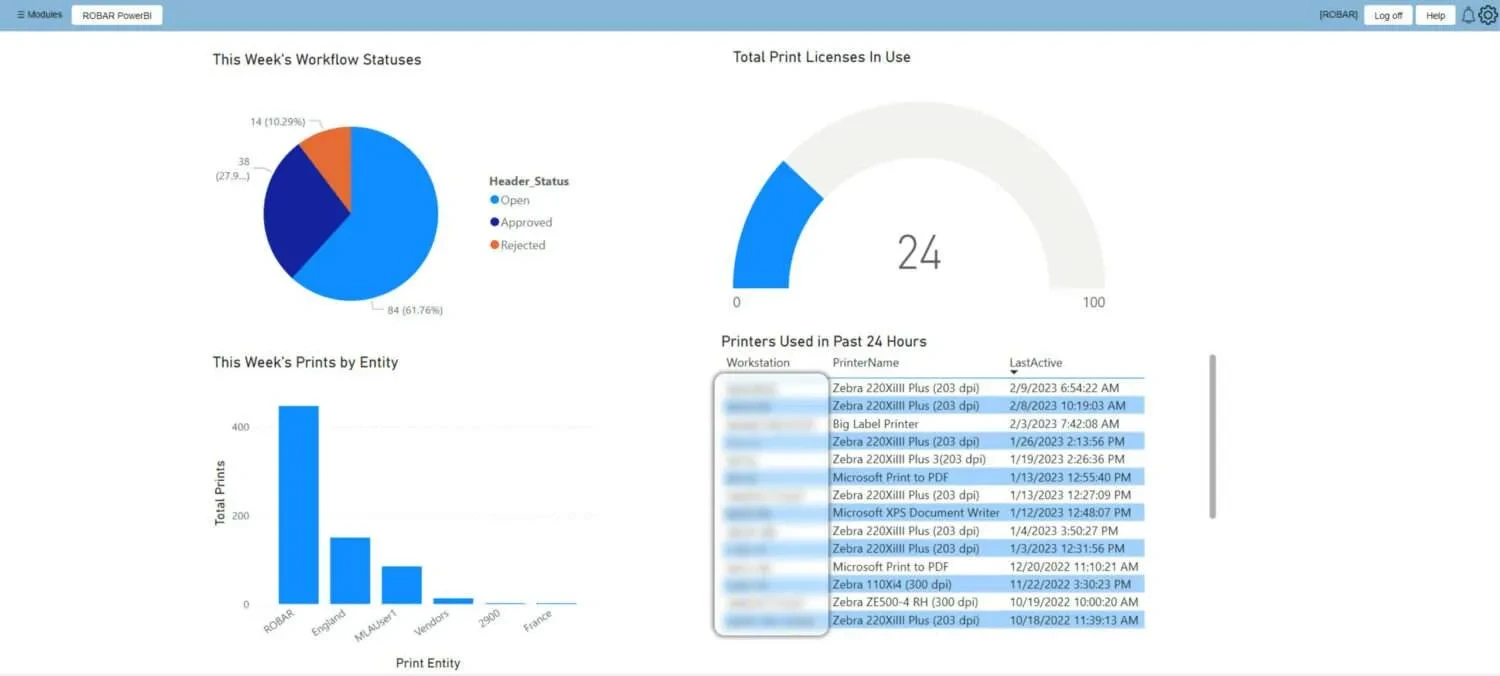
Web-based Approvals: The available workflow module replaces
cumbersome paper-based approval SOPs with automated electronic workflows.
It does not require a client-side installation, which simplifies implementation
and saves system resources since clients merely run a web browser versus an
installed application. It also allows authorized users to view approval activities
and statuses in real-time from a secure web portal. |
|
 |
Simplified Updates & Upgrades: While ROBAR meets the
vast majority of user requirements out-of-the-box, new customers routinely
request new features to meet their own specific needs. Sometimes these features
are highly proprietary and other times they offer potential value to the market
at large. In either case, all new ROBAR features are added to the base product
as standard functionality. Thus, in the event of an update, IT can choose
whether or not to activate new features by turning them on in the system settings
file. If they do not activate any new features, the new version behaves exactly
like the previous version. In other words, ROBAR eliminates the need to back-apply
and re-validate any label system customizations. |
|
 |
Configuration vs. Customization: At Innovatum, we firmly
believe in empowering our customers with the tools to implement and manage
their FDA-regulated software with minimal assistance. Consequently, ROBAR
has unrivaled flexibility to ensure that most " if not all " user requirements
can be met out-of-the-box by configuring system settings, versus custom programming: |
|
 |
Field Names: All ROBAR field names can be edited by
Administrators to match internal nomenclature and SOPs. |
|
 |
System Settings: ROBAR incorporates best practices
from multiple leaders in Life Science manufacturing. As with any complex
process, however, there are multiple ways to achieve the same outcome.
Thus, ROBAR gives Administrators the power to configure each function
to best meet their specific needs and existing procedures without the
need for custom programming.If you would like to learn more about how
ROBAR's powerful administrative capabilities can help improve your regulated
labeling operations, contact us today for a free
consultation. |